Charging ahead, safely: the next challenge for electric delivery fleets
As electric delivery fleets grow, safe battery charging becomes critical. Learn why charging cabinets matter and how SCARP keeps lithium-ion fleets protected.
As cities go emission-free, the humble battery charger is quietly becoming one of the most important pieces of kit in last-mile logistics.
Electric last-mile delivery is booming, and the reasons are hard to ignore. Zero-emission zones are rolling out across the Netherlands and Germany, diesel vans are being pushed out of city centres, and operators are switching to electric cargo bikes and light electric vehicles to keep serving their customers. It's a shift we see every day at Cycle, and it's exactly what our vehicles are built for.
But every electric fleet has a less visible side that rarely makes the headlines: what happens when all those batteries come back to the depot at the end of a shift and need to be charged. As fleets grow, so does the number of lithium-ion batteries being charged under one roof, often overnight and unattended. Getting that right has quietly become one of the most important operational questions in the industry.
A growing fleet means a growing responsibility
Lithium-ion batteries are safe when they are handled well, but the numbers show why they deserve respect. In 2025, the Dutch fire services registered 430 incidents involving battery-powered vehicles, a 20% increase on the year before. The concern with lithium batteries is a phenomenon called thermal runaway: once a cell fails, a fire can develop extremely quickly, is difficult to extinguish with a standard extinguisher, and can even reignite days later.
For a delivery operator, that risk is concentrated in exactly one place: the spot where dozens of batteries are charged together. It's an operational risk, a safety risk for staff, and increasingly a business risk too, as insurers now look closely at how companies store and charge their batteries when policies come up for renewal.
Regulation is catching up fast
This is no longer just good practice, it's becoming the rule. In the Netherlands, the PGS 37-2 guideline sets out how lithium-ion batteries should be safely stored and charged in a commercial setting, and it is expected to become legally binding through the Environmental Act around 2027. In Germany, where the topic is fast becoming just as prominent, standards such as VDMA 24994 are driving the same conversation about safe battery charging and storage.
Our advice to fleet operators is simple: don't wait for the deadline. The businesses that get ahead of this now will save themselves a scramble later, and they'll be in a far stronger position with both regulators and insurers.
Why an ordinary power socket isn't enough
The instinct is often to line batteries up against a wall and plug them in. At the scale a delivery fleet operates, that approach quickly runs into trouble: no fire separation if a single cell fails, no ventilation to carry away gases, no early detection, and no control over how much power is being drawn at once. It's the difference between charging a phone and running a small energy hub every night.
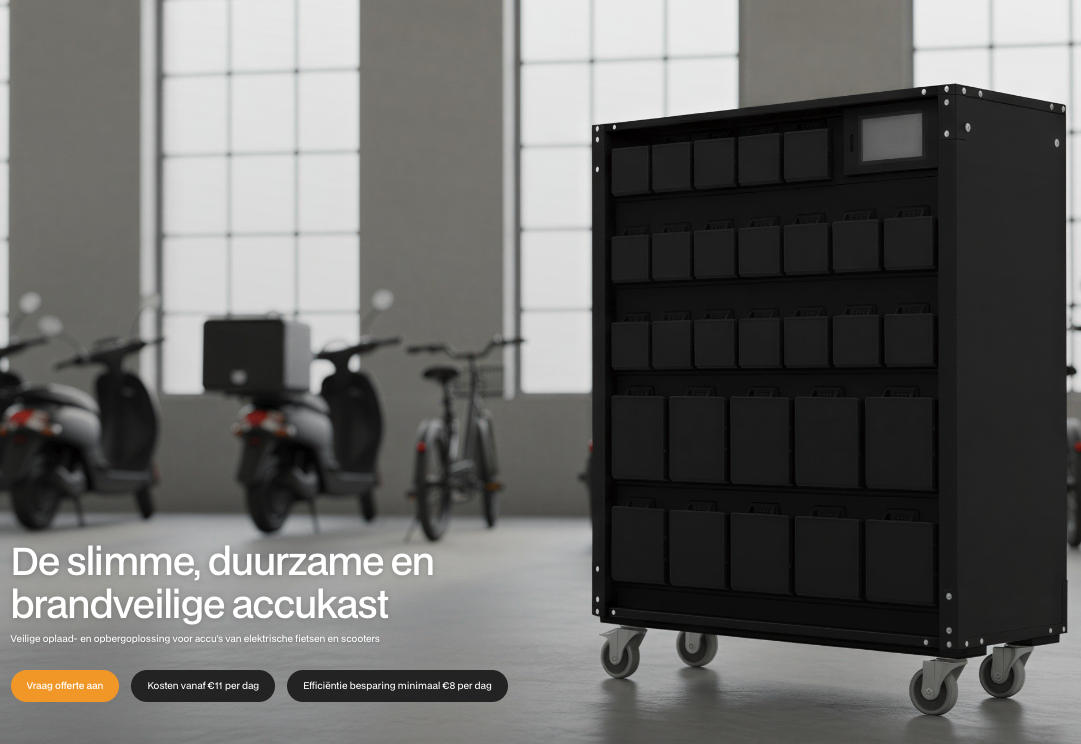
This is where purpose-built charging cabinets come in, and it's why we've been recommending them to our partners. A good charging cabinet is designed from the ground up for exactly this job: fire-resistant construction that contains an incident, ventilation and extraction to handle heat and gases, monitoring and detection to catch a problem early, and smart, balanced charging so many batteries can be topped up safely and efficiently overnight.
A solution we trust: SCARP charging cabinets
For this challenge, we work together with SCARP, a specialist in safe and smart charging solutions for professional electric fleets.
SCARP combines the safe storage and charging of batteries with monitoring, detection and smart charging management. This creates one central solution where fleet operators can not only charge their batteries safely, but also maintain continuous insight and control over the charging process.
The charging cabinets are designed for organisations that handle larger numbers of lithium-ion batteries on a daily basis, where safety, operational continuity and scalability are essential.
For delivery operators, this transforms battery charging from a daily operational vulnerability into a controlled and professional part of their infrastructure.
But SCARP goes beyond safe charging alone. Through the same platform, organisations can also monitor and manage battery status, vehicle safety and maintenance notifications from one central environment. This brings both the charging process and the operational condition of the fleet together in one clear overview.
The bigger picture
The move to emission-free delivery is one of the most positive shifts our industry has seen, and it's accelerating. But the transition only really works when the whole system is thought through, right down to how the batteries are charged at the end of the day. Get that right, and safe, smart charging stops being a headache and becomes a quiet competitive advantage: lower risk, easier compliance, and a fleet that's ready for whatever the next city rolls out.
Thinking about how to charge your fleet safely as it grows? We'd be glad to talk it through, and to introduce you to the charging solutions from Scarp that we trust ourselves. Get in touch with the Ebike4Delivery team.


